
When we talk about intelligence, we usually think about humans—our ability to solve problems, learn languages, create technology, and shape the world. But the animal kingdom is full of surprising brilliance. Many animals show advanced memory, problem-solving skills, communication abilities, and even emotional intelligence. While animals don’t take IQ tests the way humans do, researchers study their learning patterns and behaviors to understand how smart they really are.
Animal intelligence varies widely from species to species. Some animals rely on instinct, while others learn from experience and adapt to new situations. For example, a pigeon can memorize hundreds of images, and an octopus can open jars, escape complicated enclosures, and even use tools. These abilities show that intelligence is not limited to mammals or creatures with large brains. Instead, it emerges in many different forms across nature.
Scientists usually measure animal intelligence by analyzing problem-solving skills, memory, tool use, communication, and social behavior. Animals that can understand cause and effect, recognize themselves in mirrors, learn from others, or work together in groups are generally considered to have high intelligence.
One important thing to remember is that intelligence in animals is not always the same as in humans. Animals evolve smart behaviors to survive in their environment. A crow doesn’t need to know mathematics, but it does need to solve puzzles to find food. A dolphin doesn’t need to build houses, but it does need excellent communication to live in a social group. In many ways, animals develop the exact type of intelligence they need most.
One of the most fascinating examples of animal intelligence comes from primates, such as chimpanzees and orangutans. They can learn sign language, use sticks to catch insects, and even plan ahead. Dolphins also show impressive intelligence by recognizing themselves in mirrors and understanding human gestures. Meanwhile, elephants display deep emotional intelligence; they mourn their dead, protect their young, and cooperate within their herd.
Birds are another surprising group. The African Grey Parrot can learn hundreds of words and understand their meaning, not just mimic speech. Crows and ravens can make tools, solve multi-step puzzles, and even remember human faces. These behaviors challenge the old belief that birds have small brains and therefore limited intelligence.
Even some small, unexpected animals show high levels of problem-solving. The octopus, for example, is known for escaping aquariums and outsmarting predators by using camouflage and creative thinking. This proves that brain structure matters just as much as brain size.
As scientists continue to study animals, our understanding of intelligence grows. We now know that emotions, communication, memory, and cooperation all play a role in how smart an animal is. And the more we learn, the more we realize how complex and impressive the animal kingdom truly is.
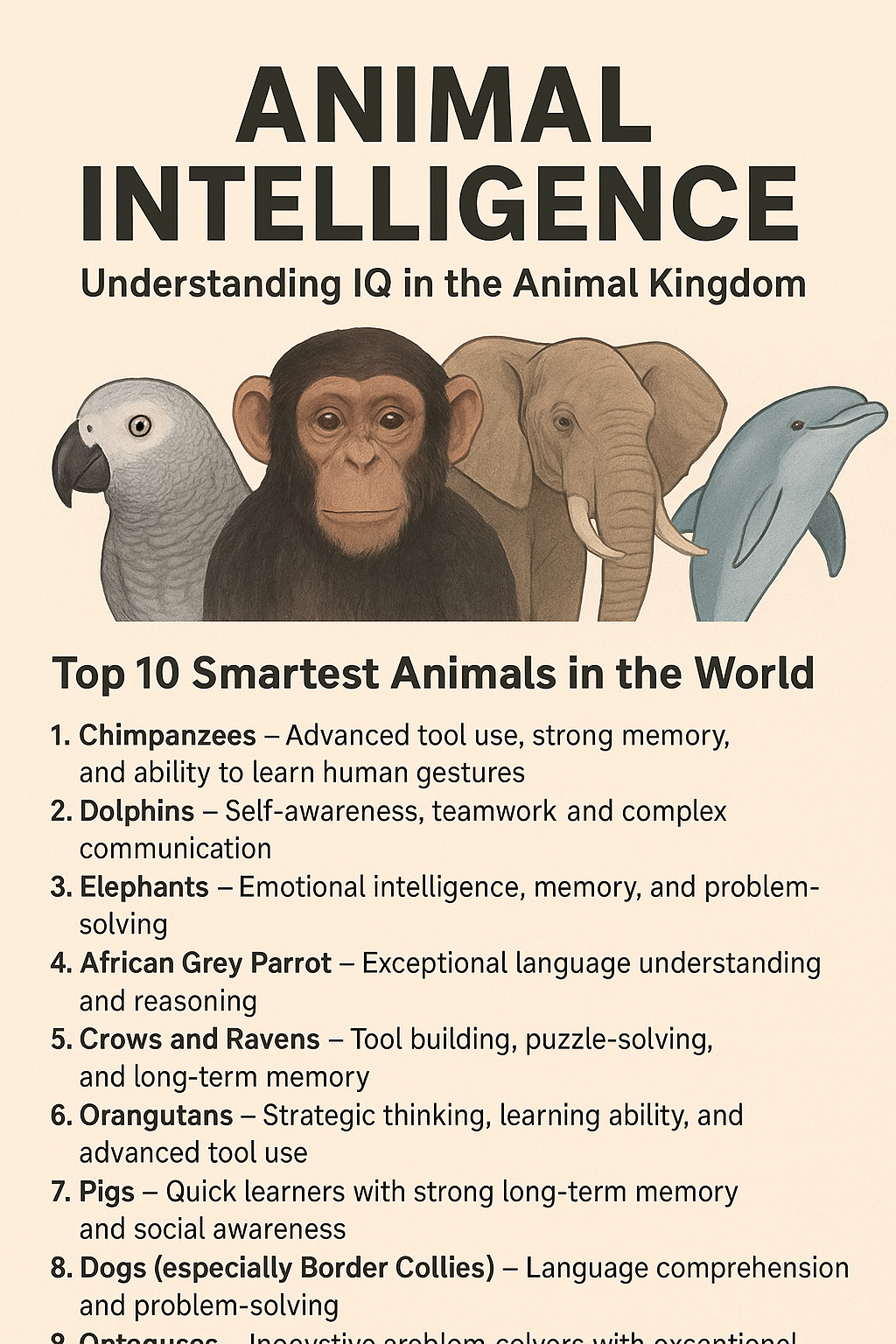
Top 10 Smartest Animals in the World
Below is a widely accepted list of the smartest animals based on research, problem-solving skills, communication, and social complexity:
- Chimpanzees – Advanced tool use, strong memory, and ability to learn human gestures.
- Dolphins – Self-awareness, teamwork, and complex communication.
- Elephants – Emotional intelligence, memory, and problem-solving.
- African Grey Parrot – Exceptional language understanding and reasoning.
- Crows and Ravens – Tool building, puzzle-solving, and long-term memory.
- Orangutans – Strategic thinking, learning ability, and advanced tool use.
- Pigs – Quick learners with strong long-term memory and social awareness.
- Dogs (especially Border Collies) – Language comprehension and problem-solving.
- Octopuses – Innovative problem-solvers with exceptional escape abilities.
- Whales – Complex communication and strong social intelligence.